
Doorbell Buttons for Duplexes, Triplexes and Multi-Unit Entrances
A shared front door with two or three units needs one button per unit. Here is how to choose a wired multi-door button station, wire it to one or more chimes, and avoid the lighted-button mistake.
DIY doorbell repairs
Use this guide to narrow the problem before you replace parts. Most wired and wireless doorbell issues come back to the push button, transformer, chime, receiver, or a basic compatibility mismatch.
On This Page
- What a multi-door button station is
- One chime per unit, or one chime with two tones?
- One chime per unit
- One chime, two tones
- Choosing between the three stations
- Wiring it
- Option A: one transformer, one chime per unit
- Option B: each unit keeps its own transformer
- Option C: one two-tone chime
- Name cards
- Mounting height and placement
- Troubleshooting after the swap
- Where to go from here
Related Categories And Products
A duplex, a two-flat, a triplex, or a house with an in-law suite usually has one street door and two or three households behind it. Visitors need a way to ring the right unit, and a pair of mismatched buttons screwed to the casing is the usual compromise. There is a cleaner answer that has been around for decades: a multi-door button station, one plate with a separate wired button and a name plate for each unit. This guide covers how they work, which one to pick, and how to wire it with the chimes and transformers you already have.
What a multi-door button station is
It is two or three ordinary wired doorbell buttons built into one faceplate. Behind each button is its own momentary contact with its own pair of screw terminals. Nothing on the plate connects one button to another. Electrically, each button is exactly the same as the single button beside any front door; the plate just keeps them lined up, labeled, and under one set of mounting screws.
We carry three from Lee Electric, all for low-voltage wired systems:
- BC203 two-family station: brass plate, two black unlighted buttons, two open name plate pockets, rated up to 16 volts.
- BC268 two-family lighted station: gold or silver plate, two white lighted buttons, two lens-covered name windows with white cards, rated up to 16 volts.
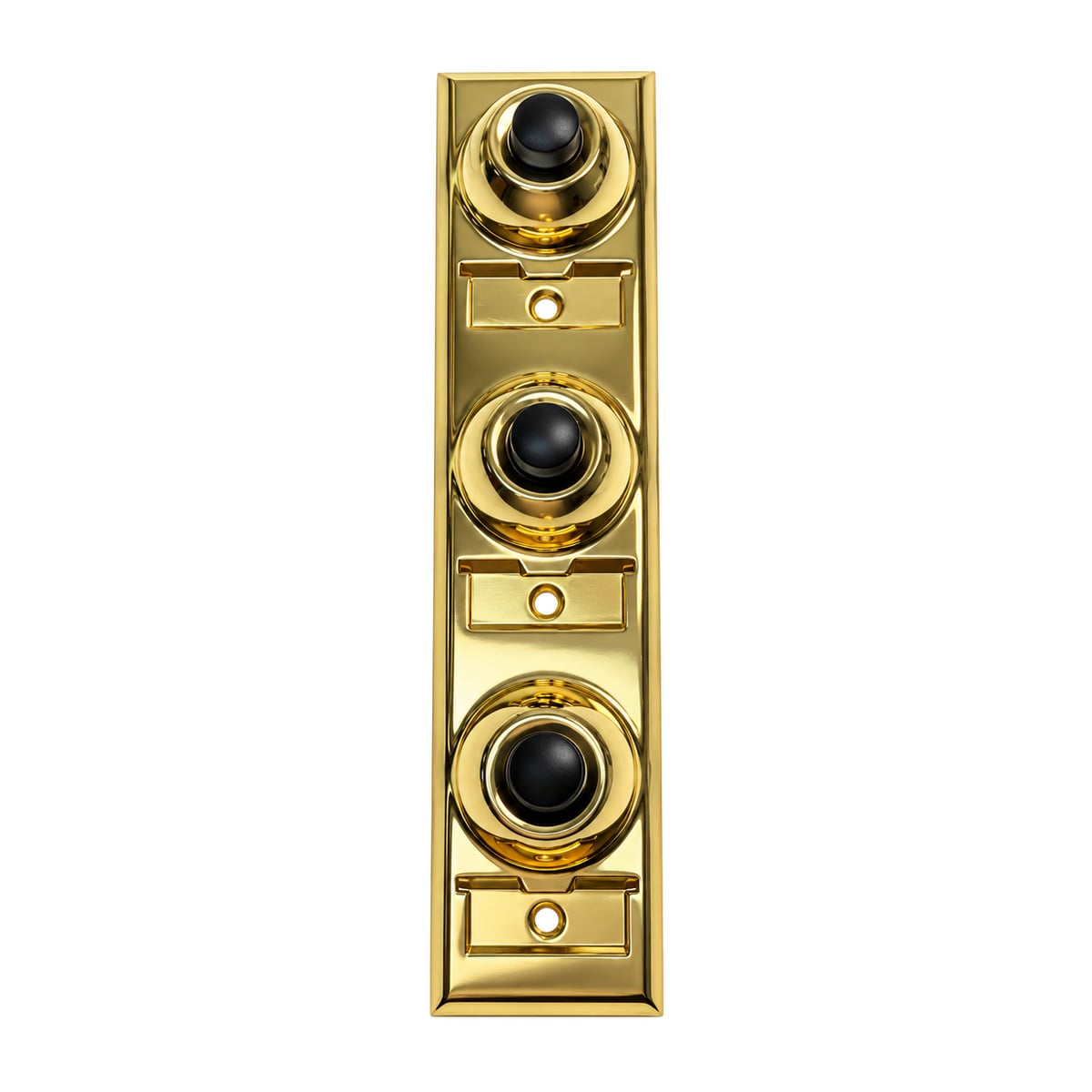
- BC208 three-family station: polished brass or polished chrome plate, three black unlighted buttons, three name plate pockets, rated up to 24 volts.
All three mount flush to the casing or wall with the wood screws in the package, and on each one the screw holes sit inside the name plate pockets so a slipped-in card hides the screw heads.
One chime per unit, or one chime with two tones?
Decide this before you buy anything, because it changes the wiring.
One chime per unit
This is what most two- and three-unit buildings want. Each unit has its own chime inside its own door, and each button on the station rings only that chime. Visitors cannot wake the downstairs tenant by ringing upstairs. You need one chime per unit and a transformer that can feed them all, or one transformer per unit.
One chime, two tones
If the two doors belong to the same household, say a house with a side door to a workshop, you can wire both buttons to one two-tone chime. Most mechanical chimes have a "front" terminal and a "rear" terminal; the front plays two notes and the rear plays one. Wire one station button to each, and the household hears which door it was. The DH300 and most of our wired doorbells have both terminals. This is not a good fit for two separate tenants, because both tones sound in the same place.
Choosing between the three stations
How many units? Two: BC203 or BC268. Three: BC208. For four or more, you are into intercom territory, which is a different product and a different budget.
Lighted or unlighted? A lighted button glows between presses so visitors can find it in the dark. It does that by passing a trickle of current through a small lamp and the chime's coil all the time, not enough to ring the chime but enough to light the lamp. Mechanical chimes, the kind with tone bars and a plunger, are fine with that. Most electronic or digital chimes are not; they hum, chirp, or refuse to ring. So: if every unit has a mechanical chime, the lighted BC268 is a nice touch. If any unit has an electronic chime, or you do not know what is inside, choose the unlighted BC203 or BC208.
Finish? The BC203 is brass-tone. The BC268 comes in gold or silver. The BC208 comes in polished brass or polished chrome. Match the door hardware, or match whatever plate you are replacing so the old screw holes and paint line are covered.
Voltage? The BC203 and BC268 are rated to 16 volts, which covers the standard doorbell transformer in nearly every home. The BC208 is rated to 24 volts, so it also suits the 24V transformers found in some older multi-unit buildings and commercial-grade installs.
Fit? The two-family plates are about 4⅞" (BC203) and 5⅜" (BC268) tall; the BC208 is about 7⅛". All are roughly 1½" to 1¾" wide. Check the push button measurement guide if you are covering an existing opening.
Wiring it
Turn off power to the doorbell transformer at the breaker first. Doorbell wiring is low voltage, but the transformer's other side is not, and a dead circuit is easier to work on anyway.
Option A: one transformer, one chime per unit
- Run one leg of the transformer to one terminal on each button of the station. One wire can daisy-chain across the buttons.
- Run the other terminal of each button to the "front" terminal on that unit's chime.
- Run the "trans" terminal of every chime back to the transformer's other leg.
Each press now closes only its own loop. Size the transformer for the load: a 16V 10VA unit is marginal for two mechanical chimes and too small for three. The T1615 16V 15VA handles two comfortably, and the DH910 tri-volt or a 30VA unit is the safer choice for three. Our FAQ on wiring two door chimes to one transformer has a diagram.
Option B: each unit keeps its own transformer
Many older buildings already have a transformer and chime in each unit. Keep them. Each station button is an independent switch, so it simply replaces the old button in that unit's loop: one unit's two wires go to one button, the other unit's two wires go to the other button. The two circuits never touch at the plate.
Option C: one two-tone chime
Transformer to one terminal on each button; the other terminal of button one to the chime's "front", button two to the chime's "rear"; chime "trans" back to the transformer. Only sensible when both doors belong to one household.
Polarity does not matter on any of these. Doorbell circuits are AC, and the buttons are simple switches.
Name cards
None of the stations come with printed names. The BC203 and BC208 have open metal pockets that take a strip of card stock or a printed label. The BC268 has a clear lens over a white card, held from the back by a snap-in carrier, so the card stays dry and cannot fall out. A label maker, a printed strip from a laser printer, or a hand-lettered card all work. Replace the card when a tenant moves out; it takes seconds and keeps the entrance looking looked-after.
Mounting height and placement
Lee's own instruction card suggests mounting push buttons 36 to 44 inches above the sill, in the same area as the door handle. Keep the station on the latch side of the door where visitors naturally reach, under cover if the entry is exposed, and away from a storm door that would swing across it. If you are covering an old plate, hold the new one over the marks before drilling: the BC208's three mounting holes are about 4¾" apart on the brass version and 4⅝" on the chrome, and the two-family plates are 3¾" (BC203) and 4¾" (BC268).
Troubleshooting after the swap
- One unit rings, the other does not. Swap the two pairs of wires at the station. If the problem moves, the wiring is crossed; if it stays, that unit's chime or transformer is the fault, not the button.
- A lighted button does not glow but still rings. The chime coil is not completing the lamp's trickle circuit. Usually an electronic chime; swap in a mechanical chime or use an unlighted station.
- Everything is dead. Check the transformer first. Our guide I can't find my doorbell transformer shows where to look and how to test it.
- Both chimes ring on either button. The two buttons' second terminals are tied together somewhere. Each button must have its own wire to its own chime.
Where to go from here
Pick the station that matches your unit count and chime type: BC203, BC268, or BC208. If you need chimes or a bigger transformer to go with it, see our wired doorbells and doorbell transformers. For a single apartment door that just needs a labeled button, the BC267LG does that on one small plate. And the whole range, single-door and multi-door, is in wired doorbell buttons, where the Door Count filter will narrow it to the multi-door plates in one click.