
800-366-7235
Since 1998

Mounting the ERA-UTX

This document does not discuss programming the ERA-UTX but rather the physical mounting of the transmitter. You do not need the smaller magnetic if using a push button only. Mounting the ERA-UTX as a Push Button You can use the transmitter as a doorbell that activates when the center button is pressed. Mounting the ERA-UTX as…

Updated: September 7, 2026Original publish date: December 14, 2022

FAQ and compatibility answers

Use this answer together with the linked product categories below. Most FAQ topics here end in a specific part — a transformer, a chime, a push button, or a receiver — and each category page compares the options we stock.

This document does not discuss programming the ERA-UTX but rather the physical mounting of the transmitter. You do not need the smaller magnetic if using a push button only.

Mounting the ERA-UTX as a Push Button

You can use the transmitter as a doorbell that activates when the center button is pressed.

  • Use a drill bit and two of the two included screws to mount the transmitter bracket. Make sure the arrow printed on the bracket is pointed up.
  • If mounting outside, ensure the grey silicon grommets covering the screw holes are inserted.
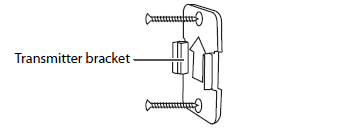
era-utx-screws-transmitter-bracket
  • Slide the transmitter down onto the bracket.
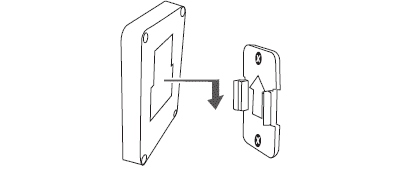
era-utx-slide-onto-bracket

Mounting the ERA-UTX as a Door/Window Contact

The ERA-UTX may also be used as a magnetic door/window contact that triggers when the smaller magnet separates from the larger piece.

  • Choose mounting locations where the magnetic contact (the smaller piece) is 1/2 inch or less from the push button (the large piece).
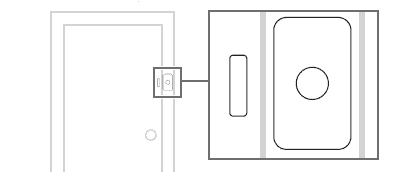
era-utx-door-window-mounting-1
  • Mount the magnetic contact with a drill and the two included screws, then snap the cover back on the magnet.
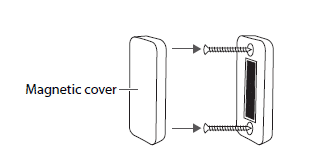
era-utx-door-window-mounting-magnetic-mount
  • Mount the transmitter bracket with the drill holes and two included screws. Make sure the arrow on the bracket is facing up.
era-utx-screws-transmitter-bracket
  • If you mount your transmitter outdoors, ensure the silicon grommets are plugged into the push button (the larger piece) to waterproof the casing.
  • Slide the transmitter down onto the bracket.
era-utx-slide-onto-bracket

More in ERA Product FAQ

Browse the full FAQ category or continue with related answers from the same FAQ category.

View category
ERA-DSDCR: Can Two Kits Alert Both Receivers?Two ERA kits can share sensors and receivers: up to 12 sensors, unlimited chime receivers, and a separate chime sound for each sensor.How Far Can You Wire Strobes to an ERA-DCRX Receiver?Quick answer: One 12 V strobe drawing 50 mA can be wired about 350 feet one way from an ERA-DCRX receiver using 20 AWG copper wire, based on a 3% voltage-drop target. Wire multiple strobes in parallel. When they share a cable, use their combined current to estimate the wiring distance. Only one zone activates at a time. Each active 12 V DC zone output can supply up to 900 mA.Can I Use My Doorbell Power Adapter in Europe or Other Countries?Yes—if your receiver’s power adapter is labeled 100–240V AC, 50/60Hz, it accepts standard household electricity in the USA, Canada, Europe, the United Kingdom, Australia and many other destinations. You may need a travel plug adapter to fit the local wall socket.My ERA-DSTX Detection Range Dropped From 25 Feet to 15Nine times out of ten nothing has failed. A PIR sensor’s usable range is a moving number set by battery voltage, thermal contrast against the background, and the angle at which the target crosses the beam pattern — none of which show up on a thermometer or a tape measure. Work the checks below in order. Most cases resolve at step 1 or step 3.How Far Will My ERA-DSTX Driveway Sensor Really Reach?A PIR sensor doesn’t measure distance — it measures contrast. It sees a target only when that target is meaningfully warmer or cooler than whatever sits directly behind it, and only when the target moves across the lens’s detection pattern rather than straight at it. Change the background temperature, the approach angle, the battery voltage, or the amount of film on the lens, and the same sensor in the same spot will “lose” ten feet of range with nothing visibly different.