
Can I Use My Doorbell Power Adapter in Europe or Other Countries?
On This Page
- What Are the LRA-PLUG, ERA-DCRX and ERA-RXPG Adapter Ratings?
- Do These Specifications Apply to Doorbell and Alert Kits?
- What Do I Need in the USA or Canada?
- What Do I Need in Europe?
- What About the UK, Ireland, Australia or New Zealand?
- What Is the Difference Between a Plug Adapter and a Voltage Converter?
- Can I Swap the ERA-DCRX and ERA-RXPG Power Adapters?
- Can the LRA-PLUG Replace an ERA-DCRX Adapter?
- What Should I Check Before Buying a Replacement?
- Can These Adapters Be Used Outdoors?
- Does International Power Compatibility Mean the Wireless System Can Be Used Anywhere?
- Still Unsure Which Adapter You Need?
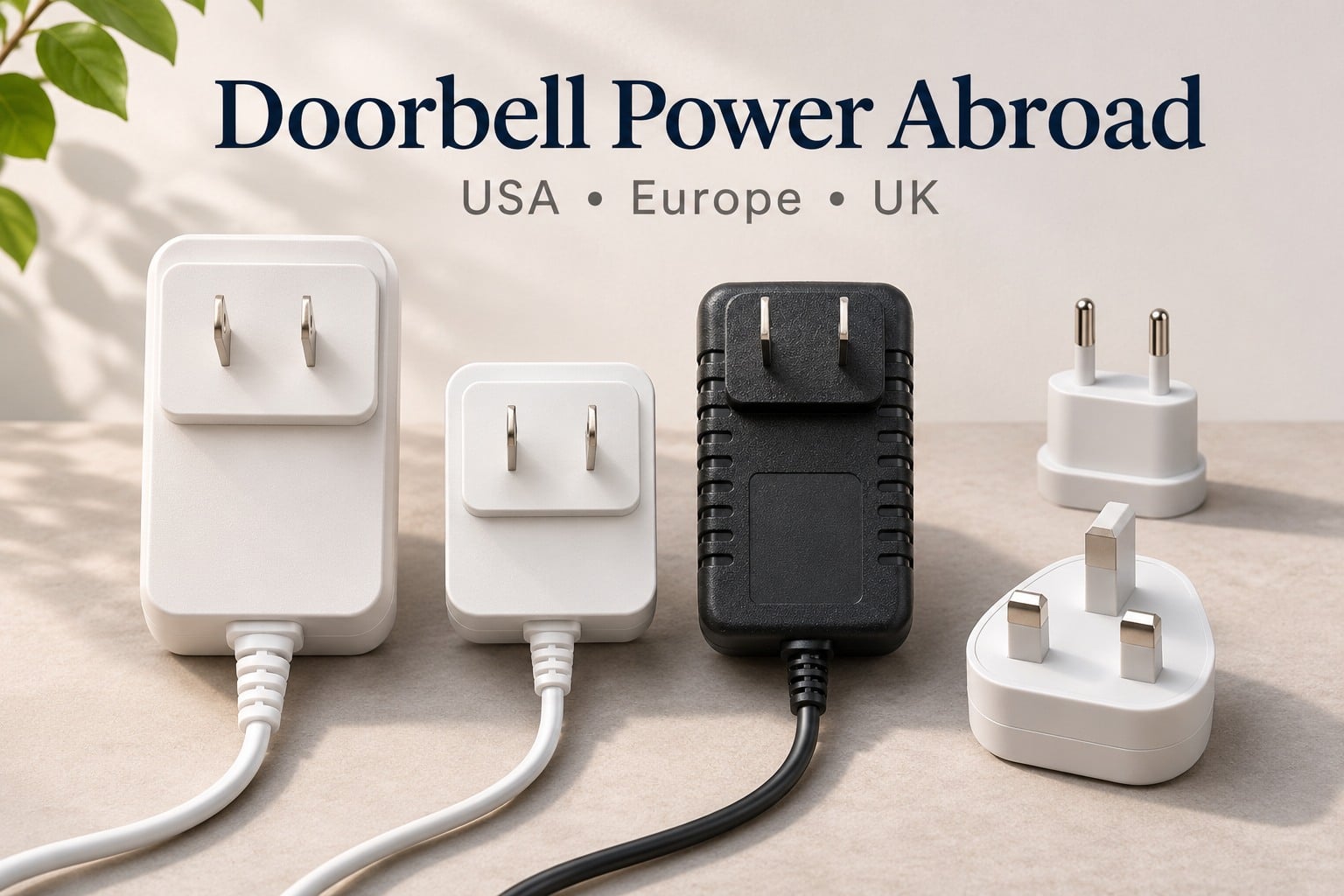
Yes—if your receiver’s power adapter is labeled 100–240V AC, 50/60Hz, it accepts standard household electricity in the USA, Canada, Europe, the United Kingdom, Australia and many other destinations. You may need a travel plug adapter to fit the local wall socket.
You do not need a voltage converter when the local electricity is within the power adapter’s labeled input range. Check the label on your own adapter before use, as specifications can vary between versions.
What Are the LRA-PLUG, ERA-DCRX and ERA-RXPG Adapter Ratings?
The following specifications describe the wall power adapter that powers the receiver. They do not describe transmitter batteries or the ERA-DCRX’s accessory output terminals.
- LRA-PLUG: Input: 100–240V AC, 50/60Hz. Output: 12V DC, 1.0A.
- ERA-DCRX power adapter: Input: 100–240V AC, 50/60Hz, 0.4A. Output: 12V DC, 1.0A.
- ERA-RXPG power adapter: Input: 100–240V AC, 50/60Hz, 0.3A. Output: 5V DC, 1.0A (1000mA).
These ratings are based on the documented adapter labels. Always match the power supply to your exact receiver model.
Do These Specifications Apply to Doorbell and Alert Kits?
For a kit, identify the receiver included in the package. A kit containing an ERA-DCRX uses that receiver’s 12V DC adapter. A kit containing an ERA-RXPG uses that receiver’s 5V DC adapter.
The LRA-PLUG provides an optional wall-power connection for compatible LRA-DCRX-L receivers that can otherwise run on batteries. Check the individual listing for package contents; the LRA-PLUG may be sold separately.
Do not apply these ratings to every ERA or LRA product. Portable receivers, other plug-in receiver models and transmitters may have different power requirements.
What Do I Need in the USA or Canada?
The documented adapters have a US-style Type A plug with two flat blades. They normally connect directly to compatible standard household wall outlets in the USA and Canada.
Use the original power adapter for your receiver and keep the connection indoors and dry.
What Do I Need in Europe?
For a power adapter labeled 100–240V AC, 50/60Hz, a European 230V household supply is within its input range. You need a suitable US-to-local-socket plug adapter when the US blades do not fit the outlet.
Many continental European destinations use round-pin sockets, but there is no single plug adapter that fits every European outlet. Select an adapter specifically suitable for the country and socket where you will use it.
What About the UK, Ireland, Australia or New Zealand?
- United Kingdom and Ireland: Use a suitable US-to-Type G plug adapter.
- Australia and New Zealand: Use a suitable US-to-Type I plug adapter.
- Other destinations: Confirm the local voltage, frequency and socket type before connecting.
The documented power supplies accept both 50Hz and 60Hz electricity, so a frequency converter is not needed within those ratings.
What Is the Difference Between a Plug Adapter and a Voltage Converter?
A plug adapter changes the physical connection so the power supply fits the wall outlet. It does not change voltage.
A voltage converter changes the electrical voltage. The documented 100–240V power supplies already accept both typical North American and European household voltages, so a voltage converter is unnecessary within the labeled range.
Connect the equipment in this order: wall outlet → travel plug adapter, if needed → correct receiver power adapter → receiver.
Can I Swap the ERA-DCRX and ERA-RXPG Power Adapters?
No. The documented ERA-DCRX adapter supplies 12V DC, while the ERA-RXPG adapter supplies 5V DC. Their matching 1.0A current ratings do not make them interchangeable.
Connecting a 12V adapter to a receiver that requires 5V can damage the equipment. Keep each adapter with its corresponding receiver.
Can the LRA-PLUG Replace an ERA-DCRX Adapter?
Both documented adapters supply 12V DC at 1.0A, but voltage and amperage alone do not establish compatibility. Connector dimensions, polarity and the receiver’s requirements must also match.
Contact customer support before substituting adapters. A plug that fits does not necessarily provide the correct electrical connection.
What Should I Check Before Buying a Replacement?
- Output voltage: Match the receiver’s required DC voltage exactly.
- Current capacity: Meet the receiver’s specified requirement; the documented adapters are rated at 1.0A.
- Connector: Confirm the correct dimensions, shape and secure fit.
- Polarity: Match the positive and negative connections.
- Input: Confirm compatibility with the local wall supply.
1000mA equals 1.0A. This is the same current rating written in different units.
Can These Adapters Be Used Outdoors?
The documented adapters are marked for indoor use. Keep them dry and protected indoors, even when the kit includes an outdoor-rated push button or driveway sensor.
Does International Power Compatibility Mean the Wireless System Can Be Used Anywhere?
No. The power adapter’s voltage rating establishes electrical compatibility only. Wireless operating permissions and product approvals are separate matters. Ask customer support about suitability before using the system outside its intended sales region.
Still Unsure Which Adapter You Need?
Send customer support your receiver or kit model, a clear photo of the power adapter label and the country where you intend to use it. Also mention whether you need a replacement power supply or simply an adapter for a different wall socket.
More in ERA Product FAQ
Browse the full FAQ category or continue with related answers from the same FAQ category.